Local-First Exports Are Easier to Trust
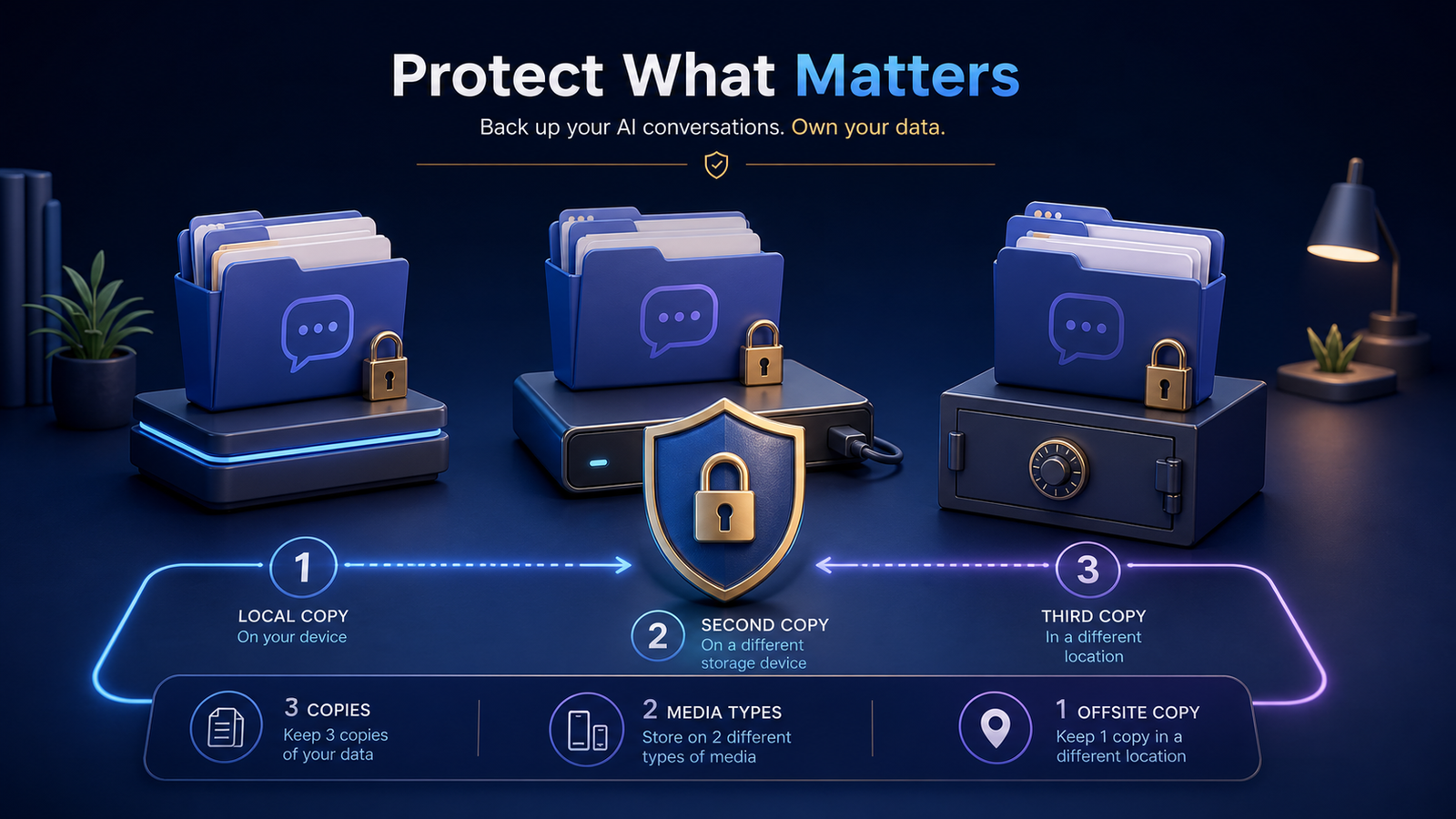
Trust grows when you can open the files, explain where they live, and restore a second copy.
Local-first exports are easier to trust because the result is ordinary files on storage you control. There is no opaque server relay required to explain the basic outcome: the conversation leaves the browser session as a package you can open, copy, encrypt, search, and back up.
Trust here does not mean “perfect security by default.” It means the system is inspectable. You can see the files, test the restore path, and decide who else gets access.
What local-first means in practice
A local-first Gemini export workflow usually has four properties:
- Capture produces files. Transcripts, media, and manifests land in folders you choose.
- Files open without the exporter. Markdown, JSON, images, and PDFs remain usable in common tools.
- Storage policy is yours. Device encryption, offline drives, and restricted folders are under your control.
- Derivatives are rebuildable. Search indexes and catalogs can be recreated from the source package.
Cloud history can still exist. Local-first simply refuses to treat the cloud UI as the only durable copy.
Why trust breaks in cloud-only history
People lose confidence in chat history when:
- They cannot tell whether an image is stored or merely rendered from a temporary URL
- Account changes, permission changes, or product changes alter what is available
- Search only works inside one product surface
- Sharing and retention rules are hard to audit
- A deleted message or expired link removes evidence they expected to keep
Official Google help covers managing Gemini Apps activity and downloading Gemini Apps data. Those controls matter. They are still not a substitute for a verified local archive of the work you must retain.
A trust checklist for any export
Before you rely on an export, verify:
- You can open the transcript in a tool that is not the original chat UI
- User and assistant turns remain distinguishable
- Local media files open from relative paths
- Important links have titles and access dates, not only raw URLs
- A second independent copy exists for material you cannot afford to lose
- Sensitivity labels match where the files are stored
- A restore test has succeeded at least once for a representative package
If a step fails, the archive is incomplete—even if the download button reported success.
Local-first is not the same as “no privacy work”
Keeping files on a laptop can still expose them through theft, malware, weak passwords, shared family accounts, or unencrypted backups. Trustworthy local archives still need:
- Full-device encryption
- Strong account authentication
- Least-privilege sharing
- Separate storage for restricted material
- Retention and deletion rules
- Restore testing
The backup and privacy guide walks through those controls in more detail. CISA’s overview of cybersecurity best practices is a good non-vendor companion for access and recovery hygiene.
How local files improve collaboration
Local packages are easier to review in ordinary work systems:
- Drop a Markdown export into a project folder
- Attach a redacted PDF to a ticket
- Commit JSON source and Markdown notes to a private repository
- Hand a complete assets folder to a teammate without requiring your browser session
Collaboration becomes a deliberate share of a specific package, not ambient access to an entire chat account.
Build trust with small proofs, not slogans
Run one proof this week:
- Export a conversation that includes an image and a link.
- Save it with a clear filename and assets folder using the organization guide.
- Move the package to a temporary directory.
- Open everything there.
- Copy it to a second encrypted location and open it again.
If those steps are easy to explain to a colleague, the workflow is trustworthy enough to scale. If not, fix the packaging before exporting dozens more chats.
Connect local-first to the rest of the system
Local files become more valuable when they are also:
- Named consistently
- Searchable across projects
- Media-complete
- Backed up with restore tests
Continue with the attachment preservation guide, the searchable archive guide, and the full export and organization system.
Bottom line
No server relay is easier to explain: the export creates a durable local library. That clarity is the foundation of trust. Pair it with encryption, careful sharing, and recovery tests, and local-first Gemini exports become not only convenient—but dependable.